
Health resources
StemWave Therapy New Jersey: Regenerative Pain Care in Central NJ
Request a StemWave consultation in Central New Jersey
Persistent knee, heel, shoulder, back, or tendon pain can make ordinary activities feel difficult. You may want to stay active, avoid medication when possible, and postpone surgery, but still need a thoughtful plan for the source of your discomfort. For patients exploring StemWave therapy New Jersey providers, regenerative pain care is one non-invasive option to discuss with a qualified medical provider.
Brunswick Internal Medicine Group provides physician-led StemWave consultations for patients in Central New Jersey, including Kendall Park, South Brunswick, Metuchen, and surrounding communities. This guide explains what StemWave is, how a visit may work, which concerns patients commonly ask about, what the evidence can and cannot tell us, and what to consider before scheduling care. It is general information, not a diagnosis or a promise of results.
What Central New Jersey Patients Should Know About StemWave Therapy
Choosing a local pain treatment should begin with the problem, not just the device. A useful evaluation identifies the location and likely source of pain, the activities you want to resume, and any warning signs that call for a different level of care. It also gives you a chance to compare non-surgical care with physical therapy, medication, injections, referral, or surgery when those options are more appropriate.
Central New Jersey patients may be interested in StemWave because appointments are external and typically brief. The practical questions are whether the therapy fits your diagnosis, what evidence applies to that diagnosis, how progress will be measured, and what the total cost will be. The practice should be able to explain each point before you commit to a course of treatment.
What Is StemWave Therapy?
StemWave is a non-invasive acoustic wave therapy used by Brunswick Internal Medicine Group as part of regenerative pain support. A handheld applicator delivers targeted acoustic energy to a selected area. The practice describes the goal as supporting the body's natural healing response, circulation, tissue recovery, and function rather than masking discomfort with medication.
The name can be confusing. StemWave is not a stem-cell injection, and treatment does not place stem cells into the body. It is an external device treatment that uses acoustic waves. The provider first reviews your symptoms and medical history, examines the area, and decides whether this approach is appropriate for your situation. A consultation matters because pain in the same body region can come from very different causes.
Brunswick's StemWave service page describes treatment as targeted, drug-free, and non-surgical. Those terms describe the treatment format, not a guarantee that every patient will improve or that another form of medical care will not be needed.
How Does StemWave Work?
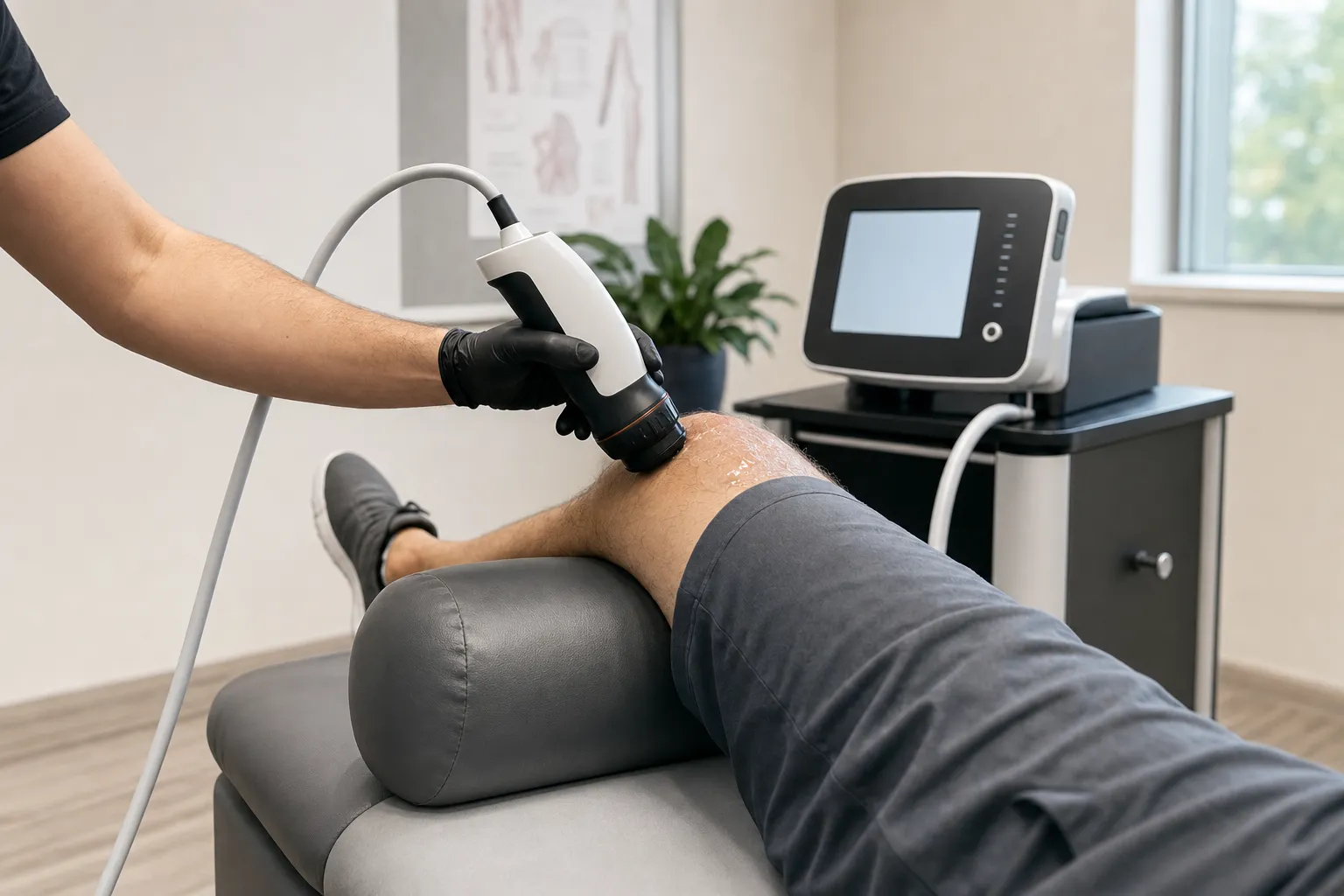
During a session, the clinician applies gel to the treatment area and moves the applicator over the selected tissue. Acoustic waves are delivered at settings chosen for the treatment plan. The energy is intended to provide a mechanical stimulus that may support local tissue response and function. Patients may feel tapping, pressure, or discomfort during portions of a session, depending on the body area and individual sensitivity.
Acoustic wave and shock wave therapies are not all identical. Devices, energy levels, treatment protocols, conditions studied, and patient populations can differ. Research about one shock wave device or one diagnosis should not automatically be presented as proof that StemWave will produce the same result. That is one reason a careful evaluation and realistic expectations are important.
In a review of extracorporeal shock-wave therapy for tendinopathies, researchers found that results varied by condition and study design. A review of shock wave therapy for knee osteoarthritis also identified a need to interpret the evidence carefully. These studies can help inform a conversation, but they do not predict an individual patient's outcome and do not replace an examination.
What Conditions Do Patients Ask About?
Brunswick Internal Medicine Group commonly discusses StemWave in relation to musculoskeletal concerns involving the neck, back, shoulder, elbow, wrist, knee, ankle, foot, muscles, tendons, and ligaments. A provider may also discuss it for certain overuse or soft-tissue complaints. The right question is not simply whether a body part can be treated. It is whether the pain has been evaluated and whether the proposed care fits the likely cause, severity, and goals.
- Knee discomfort: pain associated with activity, overuse, or selected degenerative concerns may warrant an evaluation.
- Plantar heel pain: people with plantar fasciitis often ask about non-surgical options, although heel pain has several possible causes.
- Tendon concerns: tendinopathy involving areas such as the shoulder, elbow, Achilles tendon, or other tendons may require a broader rehabilitation plan.
- Back, neck, and shoulder pain: muscular or soft-tissue pain can have many causes, including conditions that need a different type of medical assessment.
- Foot, ankle, hip, or wrist symptoms: a consultation can help determine whether the source is joint, tendon, nerve, bone, or another structure.
This list is not a list of guaranteed indications. New numbness, weakness, trauma, fever, unexplained swelling, chest pain, loss of bladder or bowel control, or rapidly worsening symptoms may require prompt medical evaluation rather than elective regenerative pain treatment.
StemWave for Knee Pain: A Non-Surgical Option to Discuss
Knee pain can affect walking, stairs, exercise, work, and sleep. It may be related to osteoarthritis, a tendon or ligament problem, bursitis, an injury, referred pain, or another condition. Before choosing a treatment, the clinician should clarify when the pain began, what makes it better or worse, whether there was an injury, and whether there are symptoms such as locking, instability, swelling, or fever.
For an appropriate patient, StemWave may be discussed as one non-invasive, non-surgical component of a broader plan. A plan could include activity modification, strengthening or mobility work, weight management when relevant, and other medical or physical therapy recommendations. StemWave should not be presented as a way to rebuild cartilage or as a substitute for every other treatment.
If knee symptoms are severe, follow an injury, or prevent weight-bearing, an in-person medical assessment is especially important. The consultation should focus on the diagnosis and your goals, not on fitting every kind of knee pain into one treatment.
StemWave for Plantar Fasciitis and Heel Pain
Plantar fasciitis is a common cause of pain near the bottom of the heel, often worse with the first steps after rest. However, heel pain can also arise from nerve irritation, stress injury, arthritis, tendon problems, or other conditions. A diagnosis is more useful than assuming every heel symptom is plantar fasciitis.
Research on extracorporeal shock wave therapy for plantar fasciopathy has reported mixed findings across protocols and outcomes. Some patients may consider acoustic wave treatment after discussing conservative options with a provider, while others may benefit from footwear changes, calf and foot stretching, progressive strengthening, activity changes, or physical therapy. The appropriate sequence depends on the evaluation.
When people ask about StemWave for plantar fasciitis, useful questions include: What is the likely source of my heel pain? What other care should I do at the same time? How will we measure progress? What happens if my symptoms do not improve? A good plan gives you answers rather than promising a quick cure.
Acoustic Wave Therapy for Tendinopathy
Tendinopathy involves changes in a tendon that can cause pain and reduced tolerance for activity. It may affect the rotator cuff, elbow, Achilles tendon, patellar tendon, or other areas. Tendon recovery can be gradual, and repeatedly loading an irritated tendon without guidance can prolong symptoms.
Studies of shock wave therapy for tendinopathy have evaluated conditions such as plantar fasciopathy and other tendon disorders, but the quality and consistency of evidence differ. The term “shock wave therapy” also covers a range of technologies and protocols. For those reasons, a study about a different machine, energy level, or diagnosis should be treated as background information, not a promise about StemWave.
For some patients, an acoustic wave treatment may be considered alongside a progressive rehabilitation program. Ask how the practice will assess tendon function, how activity will be adjusted, and what follow-up will look like. Improvement should be assessed by useful measures such as pain during specific activities, strength, range of motion, and function, not by a single number alone.
What Happens During a StemWave Consultation?
Brunswick's consultation process is designed to start with your symptoms and goals. A typical visit may include:
- History and discussion: You describe the location, duration, severity, triggers, prior treatments, medications, injuries, and functional limitations.
- Clinical evaluation: The provider examines the area and considers whether further evaluation, imaging, referral, or a different treatment is appropriate.
- Target-area plan: If StemWave is considered suitable, the team explains the area to be treated, the expected sequence, and how progress may be tracked.
- Treatment session: Gel is applied and targeted acoustic waves are delivered with an external applicator. Treatment is non-invasive and does not require an incision.
- Follow-up: The plan is reviewed over time. If symptoms, examination findings, or goals change, the treatment approach may also need to change.
Care plans at Brunswick commonly range from 8 to 12 sessions, and the practice states that patients typically see significant improvement after 3 to 4 treatments. Those are practice-level expectations, not a guarantee. Some people may respond differently, and a treatment plan may be changed or stopped if it is not meeting its goals.
How Many StemWave Sessions Might You Need?
There is no universal number of sessions for every diagnosis or patient. The number can depend on the body area, how long symptoms have been present, the likely cause, prior care, treatment response, and the goals established at the consultation.
Brunswick's published care pathway commonly uses 8 to 12 sessions with progress tracking. The practice also reports that some patients notice improvement earlier, while significant improvement is typically described after 3 to 4 treatments. Ask for a clear explanation of how the team defines improvement and when it will reassess whether continuing makes sense.
Do not judge a treatment solely by whether you feel different immediately afterward. Short-term changes in pain can be temporary. Your provider can help you look at function over time, such as walking farther, climbing stairs, returning to exercise, sleeping better, or performing work tasks with less limitation.
Is StemWave FDA-Cleared?
Brunswick's website identifies StemWave as FDA-listed or FDA-registered, not FDA-cleared. That distinction should be clear to anyone comparing regenerative pain treatments. The FDA explains that establishment registration and device listing do not by themselves mean that a device is approved, cleared, or authorized. The terms “FDA registered” and “FDA certified” can be misunderstood when used without context.
For more information, see the FDA's explanation of what FDA registration and listing mean. Brunswick does not represent StemWave as FDA-cleared in this article. Patients should ask the provider and device manufacturer for the current regulatory information that applies to the specific device and use being discussed.
Regulatory status is only one part of a treatment decision. You should also ask what condition is being evaluated, what evidence supports the proposed protocol, what alternatives exist, what risks are possible, and how the provider will respond if the treatment does not help.
Safety, Risks, and Who Should Ask More Questions
StemWave is delivered externally and is generally described by the practice as non-invasive, with no anesthesia, numbing cream, or recovery period required. Non-invasive does not mean risk-free or appropriate for everyone. Possible short-term effects may include treatment-site tenderness, redness, bruising, or temporary discomfort. Your provider should review risks in the context of your health history and treatment area.
Tell the practice about medications, bleeding or clotting conditions, implanted devices, pregnancy, recent procedures, cancer history, infection, significant nerve symptoms, and any other medical concerns before treatment. The provider can determine which details matter for your situation. Do not stop a prescription medication or postpone necessary medical care because of information in an online article.
Seek urgent medical help for new loss of strength or sudden severe pain after an injury. Urgent assessment is also needed for a cold or pale limb, new loss of bladder or bowel control, chest pain, shortness of breath, or signs of a serious infection. Call 911 for a medical emergency. Elective pain treatment is not a substitute for emergency assessment.
StemWave Compared With Injections, Medication, or Surgery
Patients often compare acoustic wave therapy with cortisone injections, pain medication, physical therapy, or surgery. The best choice depends on the diagnosis and the balance of potential benefits, risks, cost, recovery time, and personal goals.
| Option | What it may involve | Question to ask |
|---|---|---|
| StemWave | External acoustic wave sessions with a treatment plan and follow-up. | Is this protocol appropriate for my specific diagnosis? |
| Physical therapy | Progressive exercise, mobility work, strength training, and activity guidance. | What movements and loads should I build safely? |
| Medication | Medicines selected around symptoms, medical history, and possible interactions. | What benefits, side effects, and duration should I expect? |
| Injection | A targeted procedure for selected diagnoses and clinical situations. | What is the expected benefit and what are the risks? |
| Surgery | An operation or procedure for conditions where structural correction is needed. | What happens if I delay or do not choose surgery? |
- Physical therapy and exercise: often focus on strength, mobility, movement patterns, and gradual return to activity. They may be part of a plan whether or not StemWave is used.
- Medication: may help some types of pain or inflammation, but medication choice depends on other conditions, interactions, and risks. Discuss options with a clinician.
- Injections: may be appropriate for selected diagnoses but have their own risks, limitations, and expected duration of benefit. An injection is not automatically better or worse than an acoustic wave treatment.
- Surgery: may be necessary for certain injuries, structural problems, or progressive conditions. A non-surgical option should not delay a needed surgical evaluation.
A useful consultation compares reasonable alternatives instead of positioning one treatment as universally superior. Ask what would make the clinician recommend another option and what the next step would be if the first plan is not effective.
How to Prepare for a Regenerative Pain Consultation
A little preparation can make the visit more useful. Write down when the pain started, whether it followed an injury, and what activities bring it on. Note whether symptoms are constant or intermittent. Include changes in sleep, walking, grip, stairs, exercise, work, and other daily tasks. These details help the provider understand function, not just a pain score.
Bring a current medication list and tell the practice about supplements, allergies, prior injections, physical therapy, imaging, and other treatments. If another clinician has evaluated the problem, bring relevant reports when possible. You do not need to diagnose yourself. Your goal is to give the team enough context to make a safe recommendation or explain why a different evaluation is needed.
It can also help to define what success would look like. One person may want to walk around the neighborhood. Another may want to return to tennis, lift a child, sleep through the night, or work a full shift. A measurable goal makes follow-up more specific. Ask how often progress will be reviewed and whether the plan includes exercises or activity guidance between sessions.
Finally, ask for the financial details before beginning. Confirm the number of recommended sessions, the price of each session or package, cancellation terms, and whether the consultation is separate. Ask who to contact with questions between visits. Clear expectations support better decisions and reduce the chance that cost or logistics will interrupt a plan that needs consistent follow-up.
Cost, Insurance, and Payment Questions
StemWave care at Brunswick is described as self-pay. The practice does not publish a single price for every patient because the plan can depend on the areas evaluated and the number of sessions recommended. Ask for the cost of the consultation, the price per session or package, what follow-up includes, and whether there are separate charges for imaging, referrals, or other services.
Ask whether your health insurance applies to any part of the evaluation or related primary care, and do not assume that a self-pay treatment will be reimbursed. Brunswick lists Cherry Financing as available for StemWave care. Financing is a payment option, not insurance coverage, so review the terms, total cost, and any interest or fees before enrolling.
Cost should be considered alongside clinical appropriateness. A lower-cost plan is not a good value if it delays diagnosis or does not fit the condition, and a higher-cost plan is not proof of better results.
Why Central New Jersey Patients Choose Physician-Led Care
Brunswick Internal Medicine Group combines internal medicine with physician-led regenerative pain support. That model can be useful for patients who want a medical history, current medications, chronic conditions, and musculoskeletal symptoms considered together. Dr. Inderjit Singh Kainth, MD, provides medical oversight for the practice.
The practice serves patients from Central New Jersey, with locations in Kendall Park and Metuchen. Its StemWave service page identifies the Kendall Park office at 3270 State Route 27, Suite 1300, Kendall Park, NJ 08824. The Metuchen office is at 17 Bridge Street, Building B, Metuchen, NJ 08840. Because services and hours can change, confirm the location and availability when you contact the office.
Patients who are not sure whether their symptoms are appropriate for StemWave can begin with a conversation rather than committing to a treatment package. The team can explain whether an evaluation, primary care visit, referral, or regenerative pain consultation is the right starting point.
Questions to Ask Before Starting StemWave
Bring a short list of questions to your appointment. Consider asking:
- What is the most likely cause of my pain, and what other causes need to be ruled out?
- Is StemWave appropriate for my diagnosis and medical history?
- What evidence supports this protocol for my specific condition?
- What improvement should we measure, and when will we reassess?
- How many sessions do you recommend, and what is the total expected cost?
- Should I also do physical therapy, strengthening, stretching, or activity modification?
- What side effects or warning signs should prompt a call?
- What alternatives are reasonable, and what happens if this treatment does not help?
These questions help keep the decision centered on your diagnosis, priorities, and informed consent rather than on a general claim about regenerative medicine.
Review StemWave treatment details and session expectations
When a Different Evaluation May Be Better
StemWave may not be the right first step for every complaint. Pain after a significant fall, a suspected fracture, a dislocated joint, or a new loss of strength needs medical assessment. Persistent night pain, unexplained weight loss, fever, a rapidly growing lump, or a hot and swollen joint also deserves prompt attention. These signs can point to a problem that requires testing or urgent treatment.
Numbness and tingling may come from a nerve rather than a tendon or muscle. Calf swelling, sudden shortness of breath, or chest pain requires urgent care. If a clinician recommends imaging, blood tests, physical therapy, or a specialist referral instead of StemWave, that recommendation is part of safe care. The goal is to identify the cause and protect function, not to select a device before the problem is understood.
Frequently Asked Questions
Is StemWave the same as stem-cell therapy?
No. StemWave is an external acoustic wave treatment. It does not inject stem cells or other cells into the body. The “StemWave” name refers to the therapy brand, not to a stem-cell procedure.
Does StemWave hurt?
People may experience tapping, pressure, or temporary discomfort during treatment. Sensitivity varies by person and treatment area. Tell the clinician if the intensity is uncomfortable so the session can be discussed and adjusted appropriately.
How long is a session?
Brunswick describes sessions as brief, commonly about 10 to 15 minutes. The full appointment may be longer because it can include history, examination, discussion, and follow-up planning.
Will I need downtime?
The practice describes StemWave as non-invasive with no routine recovery period. Your provider may still recommend temporary activity changes based on the condition being treated. No downtime does not mean that you should immediately return to every aggravating activity.
Can StemWave replace surgery?
Not always. Some patients explore non-surgical care, but certain injuries or structural conditions need surgery or another specialist treatment. A clinician should assess your situation before you decide.
Is StemWave covered by insurance?
Brunswick describes StemWave care as self-pay. Coverage rules can change and depend on the service, plan, and diagnosis, so ask the office and your insurer about your specific situation. Cherry Financing may be available, but financing is not insurance.
Explore StemWave Regenerative Pain Care in Central New Jersey
If persistent musculoskeletal pain is limiting your activities, a consultation can help you understand possible causes and options. Brunswick Internal Medicine Group can discuss whether StemWave is appropriate, what a care plan may involve, and what alternatives should be considered. Request a StemWave consultation or call the practice at 732-940-7777.
Individual results vary. The practice determines suitability in consultation, and this article is for general information only. For related condition-specific information, read StemWave therapy for carpal tunnel: benefits and limits. If you are experiencing a medical emergency, call 911.
Sources and Further Reading
- Brunswick Internal Medicine Group: StemWave regenerative pain therapy.
- FDA guidance on device registration and clearance.
- Systematic review of shock-wave therapy for tendinopathies.
- Systematic review of shock-wave therapy for plantar fasciopathy.
- Systematic review of shock-wave therapy for knee osteoarthritis.